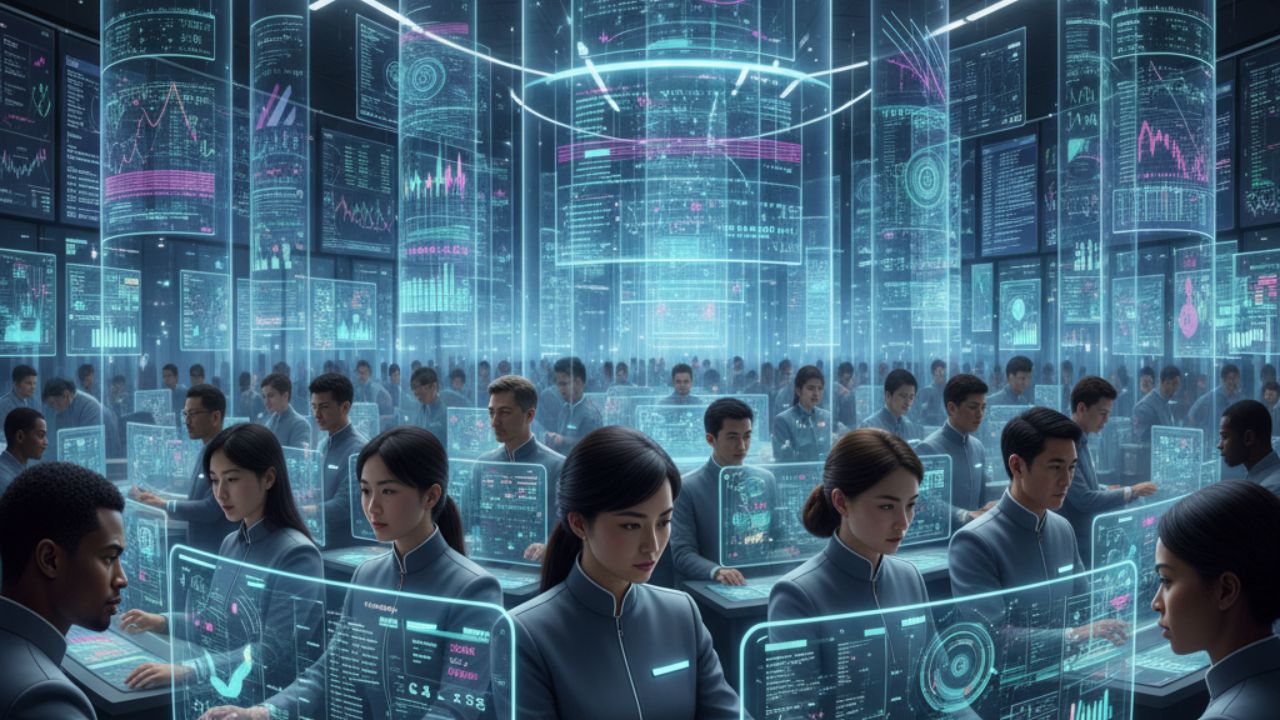
Financial markets move incredibly fast. While a human trader blinks, millions of shares can change hands across the globe. This rapid exchange of assets relies on highly advanced computer systems and complex algorithms. Large financial institutions use these systems to execute thousands of trades in a fraction of a second. This practice is known as high-frequency trading, and it has completely transformed the modern stock market.
High-frequency trading accounts for a massive portion of daily trading volume in equities, futures, and foreign exchange markets. Instead of analyzing a company’s balance sheet or quarterly earnings, computers look for microscopic price discrepancies. They buy and sell within microseconds, capturing tiny profits that add up to millions of dollars by the end of the trading day.
Understanding this invisible ecosystem helps regular investors make sense of modern market dynamics. Throughout this guide, you will learn exactly how these powerful algorithms operate and why they are so profitable. We will explore the cutting-edge technology behind the trades, the impact these systems have on the global economy, and the controversies that continue to surround them.
The Mechanics of High-Frequency Trading
At its core, high-frequency trading relies on sheer speed. Firms utilize automated trading platforms that process market data and execute orders much faster than any human possibly could. When a profitable opportunity arises, the algorithm sends an order to the exchange. If the firm’s computer is faster than its competitors, it wins the trade.
One common strategy is market making. A high-frequency trading firm will simultaneously place buy and sell orders for a specific stock. The firm profits from the bid-ask spread, which is the tiny difference between the highest price a buyer is willing to pay and the lowest price a seller is willing to accept. Because these firms execute millions of these trades daily, fractions of a penny per share accumulate into massive revenues.
Another primary mechanic is statistical arbitrage. Algorithms constantly monitor the prices of correlated assets across different exchanges. If a stock is trading for slightly less on the New York Stock Exchange than it is on a European exchange, the computer will instantly buy the cheaper shares and sell the more expensive ones. The price discrepancy usually lasts for only a few milliseconds, requiring unparalleled computational speed to execute successfully.
Key Technologies and Algorithms
To maintain their competitive edge, high-frequency trading firms invest billions of dollars in technology. Standard internet connections are far too slow for this industry. Instead, these firms build proprietary networks using microwave towers, laser communication systems, and transatlantic fiber-optic cables.
Colocation is a vital part of this technological arms race. Firms pay premium fees to place their trading servers in the exact same data centers that house the exchange’s servers. Shaving a few feet off the physical distance between the computers can save precious nanoseconds. In this industry, a nanosecond can be the difference between a highly profitable trade and a missed opportunity.
Hardware is equally important. Rather than relying on standard computer processors, trading firms use Field Programmable Gate Arrays (FPGAs). These custom-built microchips are hardwired to execute specific trading algorithms at lightning speed. By bypassing normal software operating systems, FPGAs process incoming market data and output trade orders with almost zero latency.
The Role of HFT in Modern Financial Markets
High-frequency trading fundamentally shapes how our financial system operates. By constantly offering to buy and sell shares, these firms act as the primary liquidity providers in the market. Liquidity refers to how easily an asset can be bought or sold without affecting its price. High liquidity means ordinary investors can easily enter or exit positions.
Because algorithms compete fiercely with one another to execute trades, they naturally drive down the bid-ask spread. A narrower spread means that everyday investors pay less to execute their own trades. When you buy a stock through a retail brokerage app and the order fills instantly at a fair price, you are often interacting directly with a high-frequency trading algorithm.
These systems also contribute to price discovery. As algorithms process news feeds, economic data, and order flow, they rapidly incorporate this new information into asset prices. The market becomes highly efficient, reflecting the true value of a company almost instantaneously based on available public data.
Advantages and Disadvantages of HFT
The rise of automated trading brings several distinct benefits to the financial ecosystem. The most prominent advantage is reduced transaction costs for all market participants. Tighter spreads save institutional and retail investors billions of dollars every year. Furthermore, the constant presence of algorithmic market makers ensures that you can almost always find a buyer or seller for your shares, even during volatile periods.
However, the disadvantages are significant and widely debated. One major concern is the increased risk of systemic market instability. Because algorithms react to the same data signals, a sudden price drop can trigger a cascade of automated selling. This phenomenon leads to “flash crashes,” where the market suddenly plummets and recovers within minutes, heavily damaging investor confidence.
Critics also point out the inherent inequality of the system. High-frequency firms spend massive amounts of capital on infrastructure, granting them access to market data milliseconds before the general public. This speed advantage allows them to front-run large institutional orders. When a pension fund places a massive order to buy a stock, algorithms can detect the order, buy the available shares, and sell them back to the pension fund at a slightly higher price.
Regulatory Landscape and Controversies
Governments and financial regulators have struggled to keep pace with the rapid evolution of algorithmic trading. Following several high-profile market disruptions, regulatory bodies worldwide began implementing rules to monitor and control automated trading systems.
In the United States, the Securities and Exchange Commission (SEC) introduced the Consolidated Audit Trail (CAT). This system tracks every order, cancellation, and trade executed across US markets, allowing regulators to investigate market manipulation and algorithmic failures. Exchanges have also implemented “circuit breakers.” These automated pauses halt trading on specific stocks, or the entire market, if prices fall too quickly, preventing algorithms from driving prices to zero during a panic.
In Europe, the Markets in Financial Instruments Directive II (MiFID II) imposes strict rules on algorithmic traders. Firms must register as investment firms, test their algorithms thoroughly to prevent market disruption, and maintain detailed records of their trading strategies. Despite these efforts, controversies remain. Many market purists argue that high-frequency trading extracts wealth from long-term investors without providing meaningful economic value.
Case Studies: Successful HFT Strategies
Several companies have mastered the art of high-frequency trading, generating astonishing profits. Virtu Financial is one of the most prominent examples. Operating as a global market maker, Virtu provides liquidity across thousands of different asset classes. In 2014, the company revealed a staggering statistic in its public filing: over a period of 1,278 trading days, Virtu only lost money on a single day. Their strategy relies on making microscopic profits on millions of trades, minimizing risk through massive diversification.
Citadel Securities represents another massive player in the space. They handle a significant portion of all retail stock trades in the United States. When retail brokerages route customer orders to Citadel Securities, the firm’s algorithms match the buyers and sellers, often providing price improvement. By capturing tiny spreads on an enormous volume of retail trades, the firm generates billions of dollars in annual revenue.
These success stories highlight the scalability of algorithmic trading. Once the infrastructure and algorithms are built, adding more trading volume costs very little. The firms that successfully optimized their technology early on have built incredibly resilient and highly profitable business models.
The Future of High-Frequency Trading
The landscape of automated trading continues to shift as new technologies emerge. Machine learning and artificial intelligence are becoming heavily integrated into trading algorithms. Instead of relying solely on hard-coded rules, AI models can analyze unstructured data—such as satellite imagery, social media sentiment, and global weather patterns—to predict short-term price movements.
Competition has also driven profit margins down. As more firms deploy fast technology, the speed advantage diminishes. Strategies that were highly profitable a decade ago now barely break even. Consequently, high-frequency firms are expanding into new asset classes, such as cryptocurrency and decentralized finance (DeFi). Digital asset markets operate 24 hours a day and are highly fragmented across dozens of global exchanges, providing a fertile ground for algorithmic arbitrage.
Cloud computing is democratizing access to trading infrastructure. While top-tier firms still rely on custom hardware and colocation, smaller quantitative funds can now rent powerful computing clusters and access historical tick data for a fraction of the traditional cost. This shift will likely increase market efficiency but also introduce new layers of algorithmic complexity.
HFT’s Impact on the Investment World
The integration of ultra-fast computers into the stock market has permanently altered how trading works. High-frequency trading firms have replaced human specialists on the exchange floor, bringing unmatched efficiency and liquidity to global markets. While the technology ensures retail investors enjoy tighter spreads and faster execution, it also introduces unique risks related to market fragility and systemic volatility.
For everyday investors, the best approach is to focus on long-term value rather than short-term price movements. Competing with supercomputers on a millisecond timescale is impossible for human traders. Instead, you can use the efficient markets created by these algorithms to slowly and steadily build a diversified portfolio.
As regulatory frameworks adapt and artificial intelligence evolves, the invisible machinery driving our financial markets will only grow more sophisticated. Understanding how these big investors operate allows you to navigate the modern economic landscape with greater confidence and clarity.