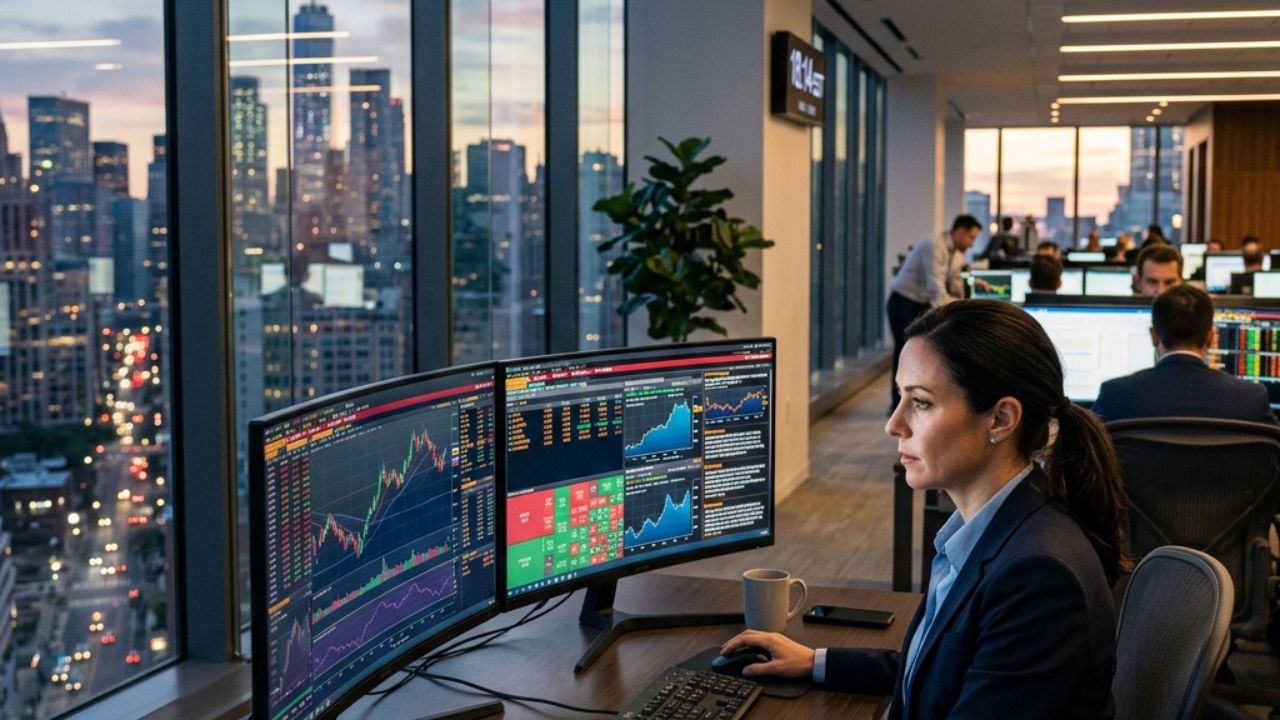
Many new traders enter the financial markets with dreams of massive, overnight gains. They focus entirely on finding the perfect entry signal or the next big breakout stock. However, the allure of consistent profits in trading quickly fades when these beginners encounter inevitable market downturns. The reality of the financial markets is much different than the highlight reels seen on social media.
Risk management serves as the absolute cornerstone of professional trading success. While amateurs obsess over how much money they can make on a single trade, professionals fixate on how much they could potentially lose. This fundamental shift in perspective separates those who survive long-term from those who blow up their accounts within a few months. Protecting your capital allows you to stay in the game long enough for your winning edge to play out over time.
This guide explores exactly how professional traders use risk management to secure consistent profits. We will cover the core principles of capital preservation, explore the mindset required for disciplined trading, and break down the specific strategies and tools the pros use every day. By the end of this post, you will have a clear blueprint for integrating robust risk management into your own trading routine.
Understanding Risk in Trading
Trading risk is the potential for losses in the financial markets. It is the built-in uncertainty that comes with buying or selling any financial instrument. Whenever you place a trade, you expose a portion of your capital to the possibility of a negative outcome.
There are several types of risk you must navigate. Market risk refers to the broad movements of the overall market. Operational risk involves failures in your hardware, software, or internet connection. Liquidity risk occurs when you cannot buy or sell an asset quickly enough without significantly affecting its price. Credit risk involves a counterparty failing to meet their obligations, while systemic risk points to a total collapse of the financial system.
Understanding these categories highlights the stark difference between speculation and professional trading. Speculators gamble on price directions without a safety net. Professional traders, conversely, calculate and accept specific risks based on tested statistical probabilities.
The Mindset of a Professional Trader
Success in the markets requires extreme emotional discipline and control. Fear and greed are the two strongest emotions that destroy trading accounts. Professionals train themselves to execute trades mechanically, rather than reacting emotionally to every tick on the chart.
This emotional control stems from the importance of a well-defined trading plan. A trading plan acts as a strict set of rules governing every action taken in the market. When you have a clear plan, you remove the burden of making rapid, emotional decisions during chaotic market hours. You simply follow the rules you established when your mind was calm.
Furthermore, professionals practice the acceptance of losses as part of the process. Losing a trade does not mean you are a bad trader. Losses are merely a business expense. Accepting this fact prevents you from making irrational choices, like moving stop-loss orders or doubling down on losing positions.
Core Principles of Risk Management
Capital preservation is the primary goal of any serious market participant. If you lose all your money, you can no longer trade. Therefore, defending your account balance takes priority over growing it.
You protect this capital by evaluating the risk-reward ratio of every potential trade. This ratio compares the amount of money you risk losing to the amount you stand to gain. For example, a 1:3 risk-reward ratio means you risk $100 to potentially make $300. Seeking favorable risk-reward ratios ensures that one winning trade can offset multiple losing trades.
Position sizing prevents over-leveraging and keeps your risk consistent. Instead of buying arbitrary amounts of shares, calculate exactly how many shares you should buy based on your stop-loss distance and your total account size. Most professionals risk only 1% to 2% of their total capital on a single trade.
Diversification also plays a role for active traders holding multiple positions. By spreading capital across different sectors or asset classes, you reduce the impact of a single catastrophic event wiping out your portfolio.
Key Risk Management Strategies and Tools
Professional traders rely on specific mechanical tools to enforce their rules. You must understand how to deploy these tools effectively.
Stop-Loss Orders
A stop-loss order automatically closes your position when the price hits a predetermined level. You can use market orders, which execute immediately at the best available price, or limit orders, which execute only at a specific price. Trailing stops automatically adjust your stop level as the price moves in your favor, locking in profits along the way. Set effective stop-losses based on technical levels rather than arbitrary dollar amounts. Avoid the common mistake of placing stops too close to your entry, which results in getting shaken out by normal market noise.
Take-Profit Orders
Take-profit orders close your position once it reaches a defined profit target. Defining these targets before entering a trade removes the temptation to hold on for too long out of greed. Balance ambition with realism. Target logical resistance or support areas based on historical price action.
Volatility Measurement
Understanding market volatility helps you adjust your position sizing. The Average True Range (ATR) indicator measures the average price movement over a specific period. If a stock has a high ATR, it swings wildly, meaning you need a wider stop-loss and a smaller position size. Standard deviation works similarly, showing how far prices typically stray from the mean.
Correlation Analysis
Assets often move together. If you buy three different technology stocks, you are essentially making one large bet on the tech sector. Understanding how assets correlate helps you reduce systemic risk within a portfolio. By mixing non-correlated assets, a drop in one sector won’t necessarily drag down your entire account.
Risk of Ruin Calculation
The risk of ruin calculates the mathematical probability of entirely depleting your trading capital. It factors in your win rate, average risk-reward ratio, and the percentage of capital risked per trade. Adjusting your strategies to minimize this risk ensures long-term survival. Lowering your risk per trade drastically reduces your risk of ruin.
Hedging Strategies
Hedging involves taking an offsetting position to protect against adverse price movements. Traders often use options, futures, or other derivative instruments to hedge. For instance, if you hold a large portfolio of stocks, you might buy put options on a market index to protect against a sudden market crash. Implement hedging when holding positions through major news events or over weekends.
Practical Application: Case Studies and Examples
Looking at real-world applications helps solidify these concepts.
First, consider an equity trader managing single stock risk. Suppose they have a $50,000 account and want to risk 1%. That means they can lose $500 on the trade. They want to buy a stock at $50 and place a stop-loss at $48. The risk per share is $2. Dividing the $500 total risk by the $2 risk per share tells them to buy exactly 250 shares.
Second, imagine a Forex trader using position sizing and stop-losses in a volatile currency pair. They observe a strong trend and want to enter, but the ATR indicates the market is moving 100 pips a day. Instead of using their standard 30-pip stop, they widen their stop to 120 pips to avoid market noise. To maintain their 1% account risk, they dramatically reduce their lot size.
Finally, picture a futures trader with defined risk-reward parameters. They identify a trade setup with a historical win rate of 40%. Because they lose more often than they win, they enforce a strict minimum risk-reward ratio of 1:3. Over a series of 10 trades, they lose 6 trades (losing 1 unit each) and win 4 trades (gaining 3 units each). Despite losing more frequently, they net 6 units of profit.
Integrating Risk Management into a Trading Plan
Knowledge means nothing without application. You must build these concepts into your daily routine.
Develop a pre-trade checklist. Before executing any order, verify that the trade meets your entry criteria, calculate your position size, and confirm your exact stop-loss and take-profit levels. If a trade does not satisfy every item on the checklist, you skip it.
Post-trade analysis and journaling act as your feedback loop. Record every trade you take, including the reasons for entry, the emotions you felt, and the final outcome. Reviewing this journal helps you identify recurring mistakes and refine your strategy.
Trading requires continuous adjustment and learning. As market conditions change, you may need to tweak your risk parameters or adapt your strategies to remain profitable.
The Role of Technology in Risk Management
Modern traders have access to powerful technology that simplifies risk management.
Most advanced trading platforms feature built-in risk tools. These platforms can automatically calculate your position size based on your account balance and stop-loss distance before you execute the trade. They can also strictly enforce daily loss limits, locking you out of your account if you lose a certain amount of money in one day.
Algorithmic risk management takes this a step further. Programmers build algorithms that automatically adjust stops, scale out of positions, and monitor overall portfolio correlation in real-time.
Finally, data analytics software helps traders identify risk patterns in their own behavior. These tools analyze your trade history to tell you which days of the week you perform best, or which specific assets cause the most losses.
Common Pitfalls and How to Avoid Them
Even with a solid plan, traders frequently stumble into avoidable traps.
Overtrading and revenge trading destroy accounts quickly. Overtrading happens when you take subpar setups out of boredom. Revenge trading occurs when you suffer a loss and immediately enter a new trade to win the money back. You can avoid this by walking away from your screens after a losing trade.
Ignoring small losses often leads to massive disasters. A trader might cancel a stop-loss order, hoping the market will turn around. The small, manageable loss snowballs into a devastating draw-down. Always respect your initial stop-loss.
A lack of a clear strategy leaves you guessing. If you do not know exactly what you are looking for in the market, you will take random trades based on intuition.
Emotional decision-making overrides logic. When you feel anxious, angry, or overly euphoric, your cognitive functions decline. Stick strictly to the rules of your trading plan to bypass these emotional pitfalls.
Transforming Your Trading Through Discipline
Consistently extracting money from the financial markets requires far more than predicting price direction. Without a protective framework, a few bad trades will inevitably wipe out months of hard work. Capital preservation, strict position sizing, and emotional control form the foundation of a lasting trading career.
Embracing these principles allows you to trade with peace of mind. By defining your risk before every trade and accepting losses as a normal business expense, you remove the anxiety that plagues novice speculators. The math works in your favor when you manage your downside effectively.
Take a hard look at your current trading routine. Start implementing robust risk management today by calculating your position sizes, respecting your stop-loss orders, and maintaining a detailed trade journal. Protecting your money is the first and most important step to growing it.